



Keep Same-Day Shipping Moving: Warehouse Strategies for Order Spikes and Mail-Service Packaging Optimization
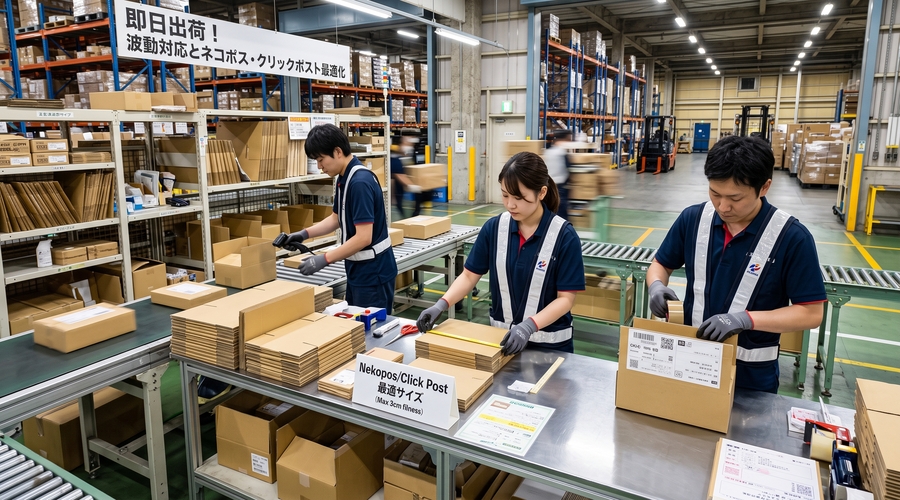
As the scale of an e-commerce business grows, companies inevitably face shipping bottlenecks caused by order spikes during major sales, large promotional campaigns, and new product launches. When orders surge within a short timeframe, warehouse operations struggle to keep up. Bottlenecks in same-day dispatch lead to shipping delays, dropping customer satisfaction rates, fulfillment errors, and a flood of customer support (CS) inquiries regarding unreceived orders.
Overcoming these order spikes while maintaining consistent shipping speeds and quality—just like during normal periods—is critical to boosting repeat purchase rates.
Drawing on insights from AnyMind Group’s global e-commerce solutions, this article outlines strategies to prevent warehouse bottlenecks during peak sales, alongside optimization techniques for standard mail-service sizes (such as Nekopos and Click Post) to maximize shipping efficiency while significantly reducing delivery costs.
Why Does Same-Day Shipping Stagnate During Mega Sales? The Reality of Order Spikes
In e-commerce, order spikes refer to drastic fluctuations in shipping volume depending on the day or time slot. During major promotional events—such as Rakuten Super SALE, Amazon Black Friday, Qoo10 Mega Waribiki, or brand anniversary sales—order volumes can surge to several, or even dozen, times higher than usual within just a few days.
Primary operational challenges that cause warehouse stalls and delay same-day dispatch include:
1. Processing Delays and Data Silos Between OMS and WMS
When order volume spikes, time lags occur during the data integration process—transferring order data from sales channels to the Order Management System (OMS) and dispatching instructions to the Warehouse Management System (WMS). Consequently, warehouse staff face downtime where orders exist in the system, but picking lists and shipping labels cannot be generated, delaying the initial operational surge.
2. Reduced Operational Speed from Inconsistent Packaging Materials and Sizes
When cardboard boxes and envelope sizes vary across products, packing teams waste time determining the optimal packaging material for each item, assembling boxes, and applying tape. While a single instance may only cause a minor delay, repeating this process thousands of times significantly reduces overall warehouse fulfillment capacity.
3. Inflated Material and Operational Costs Driven by Standard Courier Shipping
Small items—such as apparel, cosmetics, supplements, and accessories—are often packed into size-60 standard courier boxes despite fitting into smaller mail services (such as Nekopos, Click Post, or Yu-Packet). This practice generates unnecessary material costs and freight expenses while introducing redundant steps, such as box assembly and void-fill insertion, which overcrowd fulfillment lines.
Optimization Techniques for Mail-Service Sizes (Nekopos & Click Post) to Boost Efficiency
Optimizing packaging to fit mail-service limits (e.g., within 3 cm in thickness)—such as Nekopos, Click Post, or Yu-Packet—serves as an effective solution to navigate order spikes and streamline warehouse operations.
Standardizing and designing product packaging around mail-service sizes delivers immediate operational improvements:
1. Standardized Materials and Zero-Assembly/Zero-Taping Workflows
Adopting specialized self-locking cardboard boxes or pre-glued padded envelopes eliminates manual box assembly and taping entirely. This reduces packing time per order from 15 seconds down to just a few seconds. Simplified workflows allow temporary staff and seasonal workers hired for sale events to join fulfillment lines immediately without extensive training costs.
2. Elimination of Undelivered Packages and Redeliveries via Mailbox Slot Delivery
Mail-service packages (e.g., Nekopos, Click Post) are delivered directly to the recipient's mailbox. Unlike standard courier shipments, this process avoids return-to-depot situations caused by customer absence. It lightens the load on delivery carriers while offering customers the convenience of receiving items even when away from home, significantly reducing delivery-status inquiries sent to customer support.
3. Fully Standardized Barcode Inspection and Label Issuance Operations
Standardizing mail-service package sizes enables a seamless workflow: scanning product barcodes using handheld terminals to automatically generate and apply shipping labels. Establishing a system where even non-expert staff can execute operations without errors provides a reliable shield against fulfillment bottlenecks during high-volume sales.
Automated Systems Built for Order Spikes: AnyMind Group Solutions
Alongside packaging and operational refinements, establishing an automated system infrastructure—capable of processing orders to dispatch instructions without time lags—is essential.
AnyMind Group Inc. operates under a BPaaS (Business Process as a Service) business model, combining software platforms with operational support capabilities to help e-commerce brands expand globally and optimize domestic commerce.
Leveraging AnyMind’s technology and logistics operations helps establish a resilient framework equipped to handle order spikes during peak sales periods.
E-Commerce Management Platform: AnyX
AnyX is an integrated platform that centralizes order, inventory, and sales data across multiple e-commerce channels—including Amazon, Shopify, Yahoo! Shopping, Qoo10, and TikTok Shop. Even during order surges, AnyX automatically converts and syncs data into dispatch instructions in real time, preventing operational delays caused by data processing lag.
Global & Domestic Logistics Platform: AnyLogi
AnyLogi is a logistics management platform connected to a network of domestic and international warehouses. It enables multi-location inventory management, automated order routing from optimal warehouses, and automated allocation of optimal packaging materials—including mail-service sizes such as Nekopos and Click Post. AnyLogi balances fulfillment line loads, reduces shipping costs, and maintains high same-day dispatch rates simultaneously.
Utilizing a network of over 20 locations across 15 countries and regions alongside advanced technology, AnyMind Group offers data-driven global e-commerce solutions beyond traditional third-party logistics (3PL) to support sustainable business growth for client enterprises.
Conclusion
Fulfillment delays caused by order spikes during major e-commerce sales and promotional campaigns pose a significant risk of losing customer trust.
Optimizing packaging for mail services like Nekopos and Click Post, standardizing packing processes, and automating data synchronization from order placement to dispatch via dedicated system infrastructures (such as AnyX and AnyLogi) are essential steps to building a resilient e-commerce logistics operations framework.
For inquiries regarding fulfillment efficiency, shipping cost reduction, or centralized e-commerce system management, feel free to contact AnyMind Group.


![[By Marketplace] Master the Requirements for Rakuten Saikyo Delivery & Amazon FBA! Domestic Mall Delivery Quality Manual](https://images.ctfassets.net/buewhk0kqxwv/6nnIJ7hAVYfUuWOr6zmElQ/f230e7d62a7e9d02105f8d1491bc656b/Gemini_Generated_Image_6od3cg6od3cg6od3__1_.jpeg)