



Slash Regional Shipping Costs! Benefits of Decentralized Fulfillment (Multi-Warehouse) and a Step-by-Step System Migration Guide
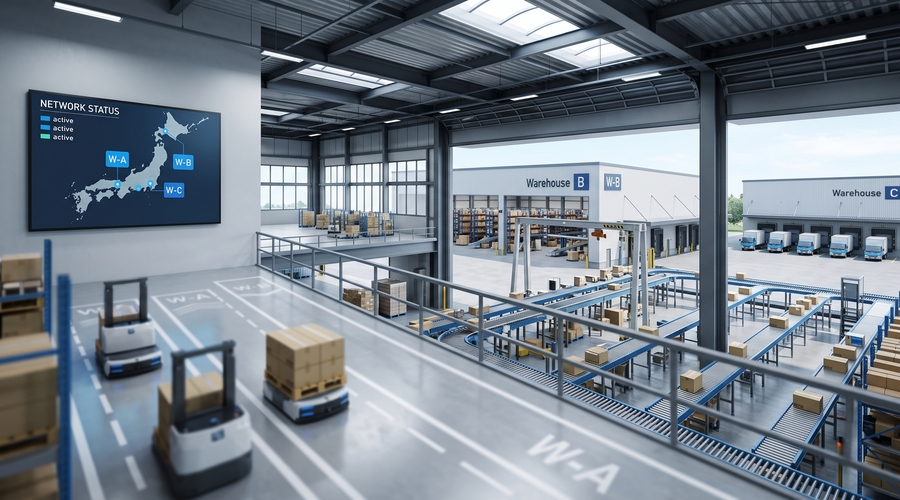
As an e-commerce business expands, two unavoidable challenges arise: rising logistics costs and the need for shorter delivery lead times. Companies shipping nationwide from a single, centralized warehouse or an East-Japan fulfillment center often face heavy regional shipping surcharges and lower customer satisfaction due to delivery delays.
A powerful solution to these issues is decentralized fulfillment (multi-warehouse) operations, which involves strategically distributing your inventory across multiple fulfillment centers nationwide.
Drawing from AnyMind Group’s expertise in global e-commerce solutions, this article explores the benefits and potential risks of decentralized fulfillment, along with a step-by-step guide to seamlessly managing systems integration and multi-inventory control.
Why Is Single-Warehouse Shipping High-Cost and High-Risk?
Many e-commerce merchants start with a single-warehouse setup (e.g., a fulfillment center near Tokyo) to ship nationwide. When order volumes are low, centralized operations offer clear benefits: inventory is consolidated in one place, and order management remains straightforward and efficient.
However, as annual shipping volumes grow and customer bases spread nationwide, several structural issues emerge:
- Surcharges on Long-Distance Shipments Carrier rates in Japan scale based on distance (distance zones). Shipping a package from Tokyo to Kansai or Kyushu costs hundreds of yen more per box than shipping locally within the Kanto area. For businesses processing tens or hundreds of thousands of orders annually, these distance surcharges accumulate into a massive drag on profit margins.
- Lead Time Bottlenecks Fulfilling orders from a single, distant location makes next-day delivery difficult, often resulting in two-day shipping times. As major e-commerce platforms and social commerce channels (such as TikTok Shop) make same-day dispatch and next-day delivery the standard, slower shipping speeds directly lead to cart abandonment and lower repurchase rates.
- Supply Chain Risks (BCP Concerns) If a single facility halts operations due to natural disasters—such as earthquakes, typhoons, or heavy snowfall—all company shipments come to a complete standstill. Diversifying warehouse locations is increasingly vital from a Business Continuity Planning (BCP) perspective to prevent supply chain disruptions.
Key Benefits of Decentralized Fulfillment (Multi-Warehouse) Operations
By establishing a multi-warehouse structure—for instance, splitting inventory between East Japan (Kanto) and West Japan (Kansai or Fukuoka)—you can unlock significant advantages:
- Drastic Reductions in Shipping Surcharges Dispatching orders from the warehouse closest to the customer minimizes long-distance freight charges and increases the proportion of lower-cost local shipments. Depending on parcel sizes and order volumes, total shipping costs can drop by 10% to 20% or more.
- Faster Lead Times (Achieving Nationwide Next-Day Delivery) A dual-warehouse model covering East and West Japan makes it possible to achieve next-day delivery coverage for over 90% of major metropolitan areas across Japan.
- Built-In Logistics BCP (Risk Diversification) If one warehouse becomes operational due to a disaster, the other location can step in and fulfill orders, ensuring your business stays up and running without interruption.
4 Steps to a Smooth, Risk-Free System Migration
While decentralized fulfillment offers huge benefits, it also carries potential operational risks—such as split inventory causing stockouts, difficulty auto-assigning orders to the optimal warehouse, or skyrocketing system integration costs.
To prevent these pitfalls, follow this 4-step migration roadmap:
Step-by-Step Implementation Strategy
Step 1: Analyze Order Data and Select Optimal Warehouse Locations
Extract historical order data from the past year (including destination prefectures, SKU order frequencies, and parcel dimensions) to run cost-saving simulations. In most cases, starting with a two-warehouse setup—such as "Kanto + Kansai" or "Kanto + Kyushu"—yields the highest immediate return on investment.
Step 2: Establish Safety Stock Allocation Rules
Define clear rules for distributing inventory across warehouses. Splitting all SKUs evenly across all facilities ties up working capital and degrades cash flow. Instead, adopt a tiered inventory control strategy: store fast-moving items (A-rank SKUs) in multiple warehouses, while consolidating long-tail products (C-rank SKUs) in a central mother warehouse.
Step 3: Enhance Integration Between OMS and WMS
The cornerstone of successful multi-warehouse execution is a robust Order Management System (OMS) equipped with automated routing logic. You need an automated system that reads the customer’s postal code, identifies the nearest warehouse, verifies real-time stock availability, and routes the fulfillment order instantly to the Warehouse Management System (WMS).
Step 4: Start Small with a Phased Rollout
Avoid decentralizing all inventory overnight. Begin with a pilot test using specific SKUs or select sales channels. Once data synchronization, packaging quality, and carrier handoffs are verified, gradually expand the strategy to cover more products and additional facilities.
AnyMind Group offers comprehensive BPaaS (Business Process as a Service) models—combining proprietary technology platforms with end-to-end logistics operations—to help e-commerce brands seamlessly transition to multi-warehouse fulfillment.
-
Formality & Tone: Written in an authoritative yet accessible professional tone suitable for e-commerce executives and logistics managers.
-
Key Terminology:
-
Delivery lead time: 配送リードタイム (Processing to arrival speed)
-
Distance surcharges / Distance zones: エリア別運賃 / 距離コスト (Zone-based carrier pricing)
-
BCP (Business Continuity Planning): 事業継続計画 (Disaster readiness and risk mitigation)
-
OMS / WMS: 注文管理システム / 倉庫管理システム (Core e-commerce fulfillment infrastructure)
-
Usage Context: Ideal for corporate technology blogs, LinkedIn posts, or whitepapers targeting B2B retail decision-makers looking to optimize supply chain efficiency.
AnyMind Group's Global & Domestic Logistics Optimization Solutions
For companies looking to overcome system integration and multi-warehouse management challenges, AnyMind Group offers a comprehensive BPaaS (Business Process as a Service) approach combining proprietary technology with hands-on operational support.
Our software platforms enable seamless multi-warehouse execution:
- E-Commerce Management Platform "AnyX" Centralizes order, inventory, and sales data across multiple e-commerce marketplaces and direct-to-consumer (D2C) channels for fully automated data synchronization.
- Logistics Management Platform "AnyLogi" Integrates domestic and international warehouse networks to manage multi-location inventory, automate order routing to the optimal fulfillment center, and optimize end-to-end delivery performance.
Leveraging our technology and logistics expertise across 15 countries and regions, AnyMind Group provides an end-to-end Global E-Commerce Solution tailored to your business growth—from domestic shipping cost reduction to future cross-border expansion.

![[By Marketplace] Master the Requirements for Rakuten Saikyo Delivery & Amazon FBA! Domestic Mall Delivery Quality Manual](https://images.ctfassets.net/buewhk0kqxwv/6nnIJ7hAVYfUuWOr6zmElQ/f230e7d62a7e9d02105f8d1491bc656b/Gemini_Generated_Image_6od3cg6od3cg6od3__1_.jpeg)